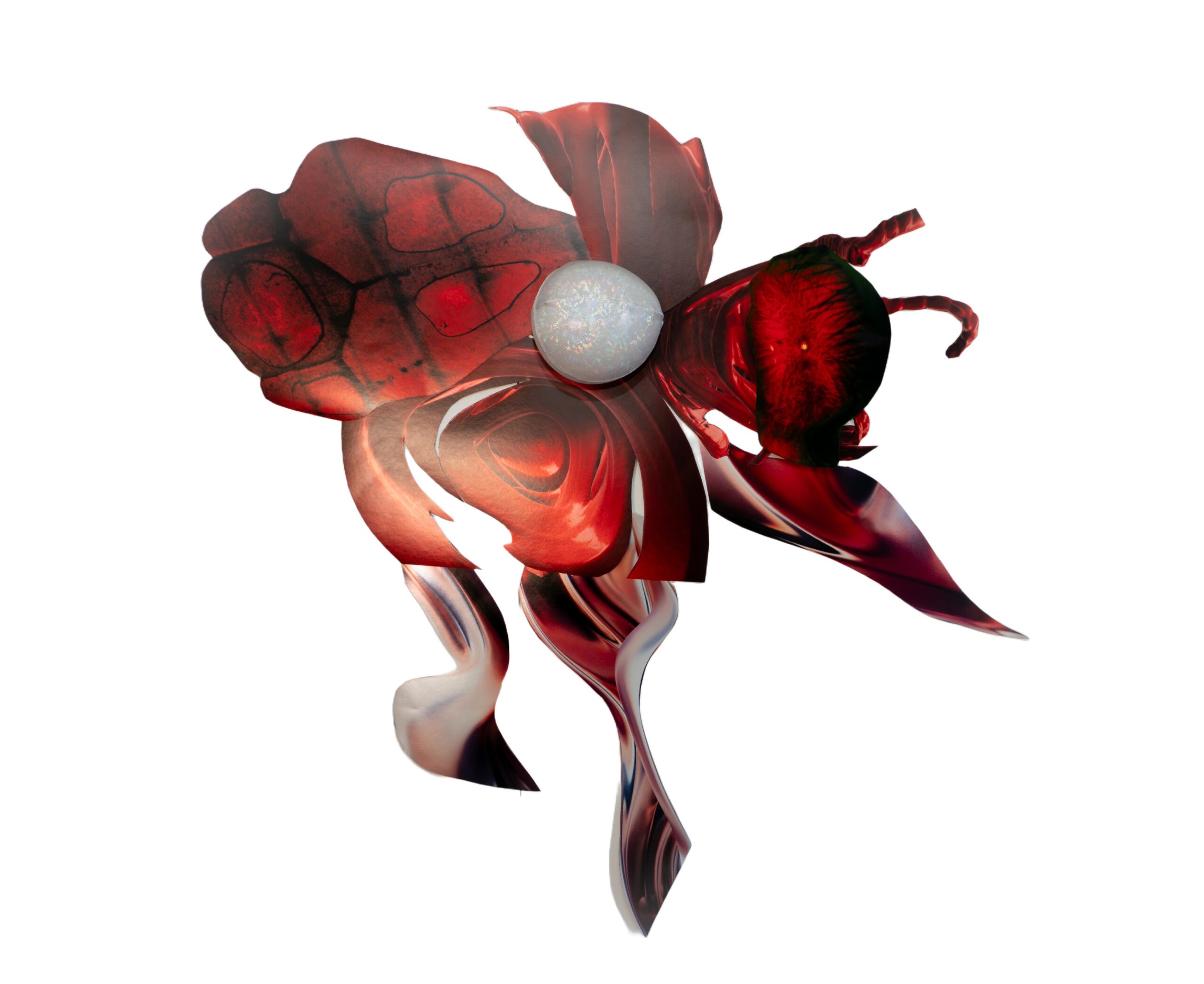
Photographic collage, 2mx2m2025 (3D microscopy photographs, inflatable, textile)
In partnership with Oulu Biocenter
Data Materialism
Data Materialism is a media-art project that explores how scientific images and environmental datasets can be translated into convincing simulations of reality — and how those simulations, in Jean Baudrillard’s sense, may become “more real than the real.” The project focuses on marine microorganisms and Baltic Sea ecologies, using microscopy, oceanographic data, and dialogue with scientists to construct a visual language that is at once documentary and speculative. Through digital photography, video, and interactive media, the work situates itself in the in-between space where the virtual is not separate from life, but an active way of experiencing, anticipating, and reshaping the real.
Scientific Partnerships & Methods
• Marine Research Institute, Klaipėda (Lithuania): During my collaboration/residency, I filmed and photographed plankton with advanced microscopy and engaged in knowledge exchanges with marine scientists. The Baltic Sea—one of the most polluted seas—faces eutrophication from excess agricultural nutrients, triggering cyanobacteria blooms that release toxins, reduce oxygen, and create hypoxic “dead zones.” These recordings ground the work in ecological urgency.
• Copernicus (EU Earth Observation): Baltic Sea data (e.g., currents, temperature, bloom dynamics) are incorporated as structural layers that inform both image and rhythm, turning measurement into material and narrative.
• Oulu Biocenter (Finland): In collaboration with the Biocenter, I produced 3D microscopic image sets of insects and snakes using scanning electron microscopy, light microscopy, tomography, and micro-tomography. These files are processed in microscope-specific scientific software, then transformed into handmade 3D photocollages and digitized assets. In Oceanaia and the new works here, many backgrounds and organisms derive from these microscope photographs, tying the micro-scale to planetary imaginaries.
• Elbuken Lab, University of Oulu: Dialogues with Assoc. Prof. Çağlar Elbuken’s Microfluidics & Biosensor Research Group (lab-on-a-chip, membrane interfaces, toward artificial cells) inform questions about intervention, synthesis, and the thresholds between living systems and designed ones.